

London's Ronnie Scott's Signed a 20-Year NoHo Lease for Its First U.S. Jazz Club. The Year of Approvals Behind It Is a Playbook for Venue Founders
Ronnie Scott's, the London jazz club open since 1959, has signed a 20-year, 11,739-square-foot lease at 250 Mercer Street for a 332-seat club, its first in the U.S. The asking rent was $1.1 million a year. Before the deal closed, the club agreed to 21 conditions with Community Board 2 to win support for its liquor license. What the deal shows about opening a live music venue in New York.
NEW YORK — One of the world’s best-known jazz clubs is coming to the city that inspired it, and it’s taking the slow route.
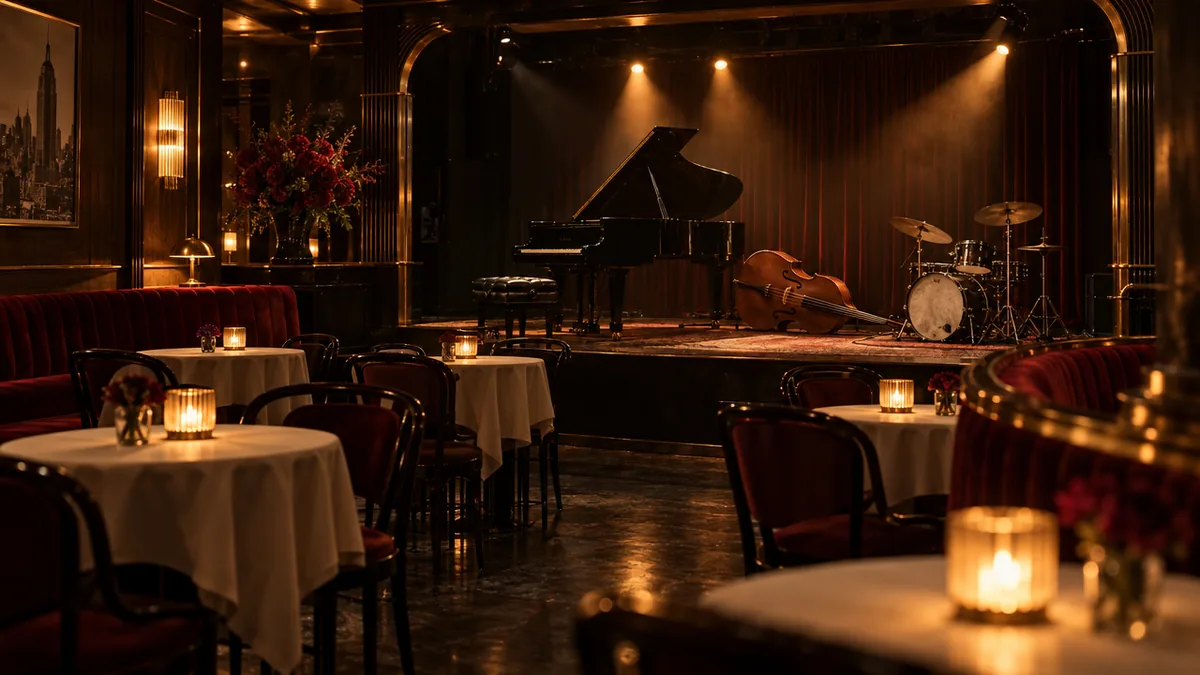
Ronnie Scott’s, which has operated in London’s Soho since 1959, has signed a 20-year, 11,739-square-foot lease at 250 Mercer Street in NoHo for its first U.S. location, Commercial Observer reported on Nov. 19. The club plans a 332-seat room with ticketed shows and dinner. Brokers Cory Zelnik and Jeremy Banilevi of Zelnik & Company, who represented both the club and the landlord, Mercer Square Owners Corporation, said the asking rent was $1.1 million a year and the deal was signed at the end of September.
“This was a yearlong negotiation which is not atypical for a deal like this,” Zelnik told Commercial Observer. “At the end of the day, it was the landlord-tenant partnership throughout that made it work.”
No opening date has been announced, according to the Village Reader, the neighborhood outlet that first reported the design plans.
A Club Built on New York
Saxophonists Ronnie Scott and Pete King opened the original club on Oct. 30, 1959, hoping to recreate the intimate, musician-run jazz clubs they had found in New York, the Village Reader reported, citing the club’s website. Commercial Observer notes that it became the first U.K. club to regularly host American jazz stars such as Ella Fitzgerald and Miles Davis.
The new home is the former Gristedes supermarket at the northeast corner of Mercer and West 3rd streets. The space has never held a liquor license and has been vacant since 2019, according to a Community Board 2 resolution. It splits into 7,406 square feet on the ground floor and 4,333 in the basement. At the asking rent, that works out to roughly $94 a square foot across both levels.
Step One: The Community Board
Before the lease was even signed, the club went to Community Board 2’s liquor licensing committee. Its first appearance was postponed. In December 2025, at the applicant’s request, the board laid the application over and asked the State Liquor Authority not to act until it came back.
In January, it did. The board’s resolution describes 97 tables, 332 seats, two standing bars and a proposed legal occupancy of 400. Because about four other licensed bars or restaurants sit within 500 feet, the application fell under the state’s “500-foot rule,” which requires an applicant to show that a new license serves the public interest.
The board’s biggest worry wasn’t noise. It was traffic: hundreds of guests arriving and leaving at once on a street with one traffic lane, a bike lane and largely residential neighbors. The resolution notes that the club had tried community outreach and received no response, and that it supplied a traffic plan.
The board voted 36-0 for a resolution backing the license only if 21 signed stipulations become part of it. Among them:
- Operate as a full-service restaurant and jazz club, with the full menu available until closing.
- Close by midnight on Sundays, 1 a.m. Monday through Thursday and 2 a.m. on Fridays and Saturdays.
- Admit guests only to ticketed events, except for no more than 12 private parties a year.
- No TVs, no velvet ropes, no promoted DJ sets, no bottle service and no “boozy brunches.”
- Use a qualified sound engineer to keep all sound inside, and get a Place of Assembly certificate from the Department of Buildings.
Step Two: Landmarks and Design
Because the building sits in the NoHo Historic District, the design needs landmarks review too. On Nov. 16, the club’s architects presented to CB2’s landmarks committee, the Village Reader reported. The plan paints the brick black, raises the parapet about three feet to hide new rooftop cooling equipment, and adds a backlit bronze band and six lit poster cases.
Some of the design choices answer the neighbors’ concerns directly:
- The entrance moves. Zoning rules require the main entrance to be at least 100 feet from residential space, so it shifts from the corner toward Broadway, under a curved bronze marquee.
- No sidewalk lines. Ticketholders will wait in a cellar lobby.
- Sound stays in. The stage is being built as a “box within a box,” and rooftop equipment will sit 20 feet back from neighboring apartments behind acoustic screens.
The committee approved it unanimously, and it was headed to the full board on Nov. 19. The city’s Landmarks Preservation Commission still has to sign off.
What Venue Founders Can Take From It
- Budget a year, or more. The lease took about a year to negotiate, and the community board process started before it was signed.
- Go to the board early, and come prepared. The club postponed its first hearing, then returned with signed stipulations and a traffic plan.
- Expect to trade flexibility for approval. Stipulations become part of your liquor license’s method of operation. A ticketed-only, no-TV, capped-private-party model limits revenue, so price it into your projections.
- Solve the neighbors’ problem in the design. Traffic, lines and sound are what boards worry about. A cellar lobby and a box-within-a-box stage answer those concerns before anyone raises them.
For more on the city’s support for venue owners, see our look at NYC’s new nightlife office leadership.