

NYC's Outdoor Dining Rulebook Is Getting 36 Separate Fines and an 11 p.m. Curfew. What Restaurant Owners Should Do Before Nov. 30
The city's Department of Transportation has proposed new Dining Out NYC rules that would allow year-round roadway cafés but split penalties into 36 separate violations, starting at $200, and move closing time from midnight to 11 p.m. What's in the proposal, what it costs, and what restaurant owners should do now.
NEW YORK — Year-round outdoor dining was supposed to be the good news for New York restaurants this winter. The fine print is now catching up with it.
The city’s Department of Transportation (DOT) has proposed a package of amendments to the Dining Out NYC rules that would put the City Council’s 2026 outdoor dining laws into practice. Alongside a new category of year-round roadway cafés, the proposal replaces the program’s short penalty list with 36 separate violations and moves the outdoor closing time from midnight to 11 p.m. every night. Public comments closed Nov. 9, and the rule page logged 408 online comments. As of this writing, the rule is still listed as proposed, not final.
What Changed, and Why Owners Are Uneasy
According to The City Reporter’s Nov. 18 report, the existing program has just two types of penalties. Under the proposal, fines generally start at $200 for a first offense and rise to $500 for repeat violations.
“The city shouldn’t be using small businesses as an ATM,” Andrew Rigie, executive director of the NYC Hospitality Alliance, told the outlet. Sandra Jaquez, president of the New York State Latino Restaurant Association, said the lost hour is significant: “That one hour, it is significant for us when it comes down to making a profit or losing that night.”
DOT argues the opposite. A spokesperson, Will Livingston, told The City Reporter that the detailed list is meant to make compliance clearer, and that “we have a 30-day grace period for restaurants to fix issues before any violation is written.”
What’s in the Proposal
The proposed rule text implements Local Laws 135, 143, 144 and 145 of 2026. The pieces most likely to hit a restaurant’s bottom line:
- Year-round roadway cafés. Roadway cafés have been seasonal. The proposal creates a year-round category. An existing roadway café could get a one-year interim license for year-round operation for $630, on top of its regular license fee, renewable only while its current revocable consent lasts. Converting a seasonal café to year-round through a license modification would require a public hearing.
- Seasonal cafés must go dark in winter. Operating a seasonal roadway café between Nov. 30 and March 31 would be its own violation.
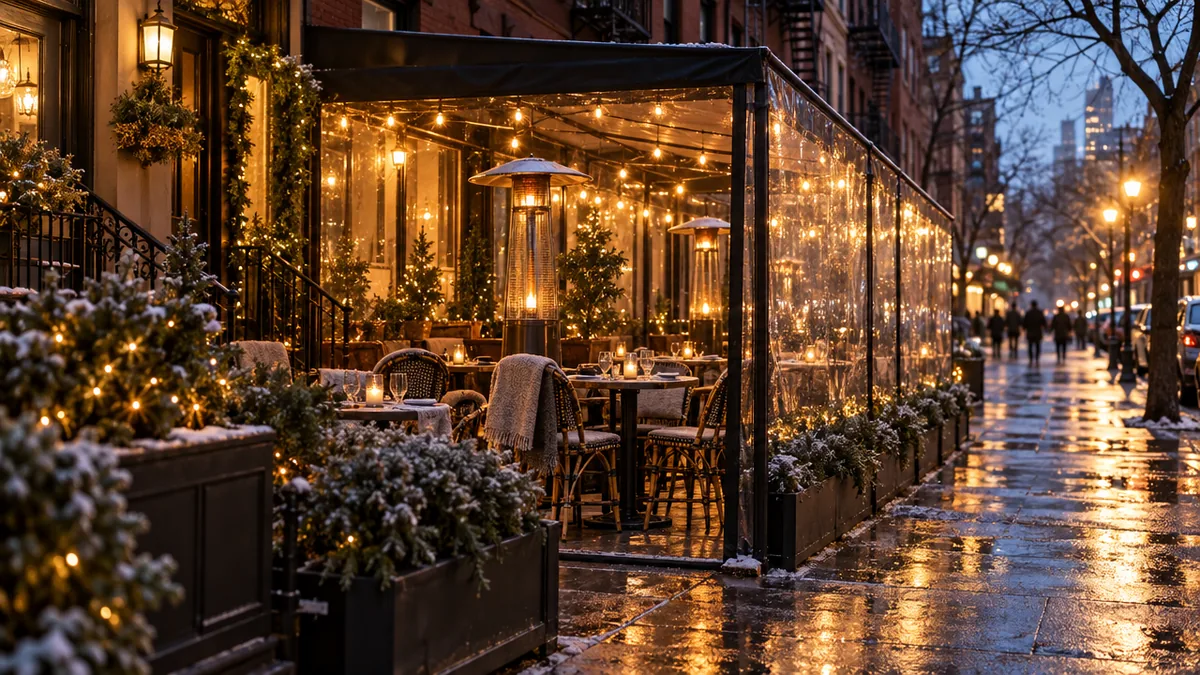
- Winter coverings. From Nov. 30 to March 31, cafés could use readily removable, transparent vertical winterization coverings. Similar vertical coverings would be allowed in other months during adverse weather, such as light rain. When DOT suspends operations for a severe weather alert, cafés must stop serving.
- Shorter hours. Closing time drops from midnight to 11 p.m., seven days a week.
- Fees. Annual fees are charged per square foot by sector. In Sector 1, for example, the rate is $6 for sidewalk and year-round roadway cafés and $5 for seasonal roadway cafés; in Sector 4 it is $31 and $25. Fees could be paid quarterly, but missing two installments in one term ends that option.
- “Service-ready” rule. During operating hours, a café must be furnished for customers, accessible, clean and not used for storage.
Among the individual violations listed in the penalty schedule: failing to keep a café clean, failing to provide direct access for people with disabilities, unauthorized music or amplified sound, keeping items in the sidewalk furnishing zone, failing to stay service-ready, not stopping service during a severe weather alert, and straying from the DOT-approved site plan.
The Other Side of the Sidewalk
Restaurants aren’t the only ones weighing in. Manhattan Community Board 5 voted to support the amendments in general while urging DOT to protect pedestrian clear paths and to offer reduced fees or other relief for small and independent restaurants, warning that compliance and winterization costs could favor larger operators. Several public commenters asked DOT to require at least one open side on enclosures so outdoor dining stays accessible to medically vulnerable diners.
What Restaurant Owners Should Do Now
Know your category. Check your license and revocable consent: sidewalk café, seasonal roadway café or existing roadway café eligible for year-round status. The answer decides whether you can serve outdoors after Nov. 29.
Don’t build for winter on assumptions. The rule isn’t final, and details could change. Before you spend on enclosures or heaters, confirm with DOT’s Dining Out NYC team (rules@dot.nyc.gov) what’s allowed for your setup this season.
Print your site plan and walk it. Many of the new violations come down to measurements and clutter: clear paths, furnishing zones, storage. A five-minute pre-shift check is cheaper than a $200 ticket.
Rethink the last hour. If your outdoor tables turn after 11 p.m., plan now for how to move those guests inside or shift reservations earlier.
Use the grace period. DOT says restaurants will get 30 days to fix issues before a violation is written. Treat any warning as a deadline, and document the fix with photos.
Get free help. The city’s NYC Business Express Service Team, which the mayor’s office says has more than doubled to 30 advisors, helps owners navigate permits and avoid fines. Our guide to the Business Owner Bill of Rights explains what inspectors owe you.
Outdoor dining kept many New York restaurants alive after 2020, and the city has now made it permanent. Whether it stays worth the trouble for a small operator will depend on how these rules land, and how they’re enforced.