

Marble Raises $5.5 Million to Put an AI Agent in the Restaurant Walk-In
Marble, a New York City startup from Y Combinator's Summer 2026 batch, raised a $5.5 million seed round led by Contrary for AI software that counts restaurant inventory by voice, forecasts demand and drafts orders and schedules. What it does, what it costs, what's still unproven, and what restaurant operators should ask.
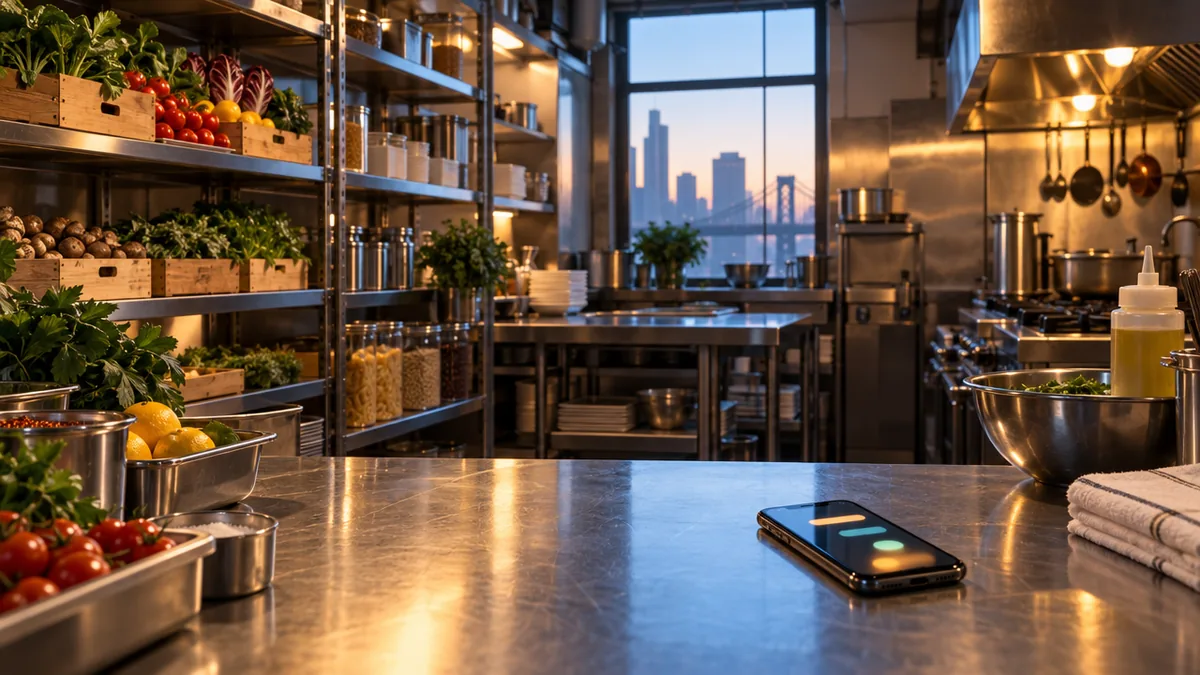
NEW YORK — The front of a restaurant has had more than a decade of software: point-of-sale systems, reservation apps, delivery platforms. The back of the house, where food costs and labor hours decide whether a busy night actually makes money, still runs largely on clipboards and spreadsheets. A young New York City startup has just raised money to change that.
Marble, which builds what it calls an AI-native operating system for restaurant back-of-house operations, announced a $5.5 million seed round on Nov. 17, led by Contrary. Y Combinator, Robinhood Ventures and Restive Ventures also participated, along with angels including Sweetgreen co-founder Jonathan Neman, according to the company. AlleyWatch listed the deal among the day’s New York rounds and put Marble’s total reported funding at $6 million.
The Founders
Marble was co-founded by CEO Aakar Khanna and CTO Arjun Chaliha, who have been friends since their freshman year at the University of Michigan, according to the company’s Y Combinator profile, which lists it as a Summer 2026 company based in New York City.
Khanna’s family has operated A&W restaurants in Canada for 10 years, and his first job out of college was as a Goldman Sachs investment banker covering the restaurant sector, Restaurant Business reported. Chaliha was a software engineer at Bloomberg, where YC’s profile says he led AI and machine learning work for electronic trading.
The idea came from the family kitchen. Khanna told Restaurant Business he once watched a general manager shout to the front to ask how many boxes of pancakes they had sold over two weeks, then use that number to place the next two weeks’ order. “There is no way that is the right way to place an order,” he said.
How It Works
Marble’s pitch has three parts:
- Count. Staff walk the storage areas and tell Marble’s mobile app what they see, or use the camera. Khanna told Restaurant Business this cuts inventory-counting time by 70% to 80%.
- Forecast. The software predicts demand from sales history plus inputs such as reservations, local events and weather.
- Act. An AI agent named Remy drafts orders, prep plans and schedules, reconciles invoices and flags problems, then sends the work to a manager to approve.
“On a Tuesday morning, it might reach out to the general manager and say, ‘Hey, I looked at the next 14 days, and I’ve drafted up six orders for you. One’s for Sysco, do you want to take a look?’” Khanna told Restaurant Business.
Marble says it can replace several separate tools for inventory, ordering, recipe management and forecasting. Khanna told the trade publication that consolidation saves operators $200 to $700 a month, and that Marble itself generally costs $250 to $450 a month, depending on the number of locations. For scheduling, it integrates with 7shifts and Sling.
Early Traction, Self-Reported
Marble is young. Restaurant Business described it as about five months old, with five employees, on track to cross $1 million in contracted revenue. Its YC profile names customers including A&W Restaurants and New York operators The Kati Roll Company, Sophie’s Cuban and Kokomo NYC.
The results the company cites are its own numbers and vary by source. Khanna told Restaurant Business the system saves 20 to 30 hours a week across employees and cuts food waste by 30% to 40%. Investor Restive wrote that customers report a 40% reduction in food waste and more than 30 manager hours saved per week. None of these figures have been independently verified.
“Within weeks of starting, Aakar and Arjun had already ripped out a dozen existing solutions. Restaurants don’t do that, unless there’s proven value,” Contrary partner Kyle Harrison said in a statement.
Why It Matters in New York
The timing fits the local mood. In the NYC Hospitality Alliance’s third-quarter survey, half of the 275 responding bars and restaurants said they were breaking even or losing money, and 45% named labor costs as a leading concern, Gothamist reported. In its announcement, Marble cited National Restaurant Association figures that 42% of operators said their restaurants were unprofitable in 2025.
Marble also isn’t alone. Restaurant Business noted a wave of “AI-native” startups entering the space, while established restaurant-tech providers are building similar AI tools of their own.
What Operators Should Ask
If a pitch like this lands in your inbox, a few questions are worth asking before switching systems:
Who approves what? Marble’s agent drafts orders and schedules for a manager’s sign-off. Make sure any tool you adopt keeps a human in control of purchasing and staffing.
What does it replace, really? Add up what you pay now for inventory, recipe costing and ordering software, and compare it with the new subscription, not with a vendor’s estimate.
How does it handle your data? Forecasts are only as good as the counts and invoices behind them. Ask what happens when staff skip a count or a delivery doesn’t match the invoice.
Can you measure it yourself? Track food cost as a percentage of sales and manager hours for a month before and after. Your own numbers matter more than anyone’s case study.
For New York operators running on thin margins, the promise is simple: fewer hours with a clipboard and fewer cases of wasted produce. Marble now has $5.5 million to prove it can deliver.