

Opentrons Raised $40 Million to Let AI Run Lab Experiments. The Queens Company Has Been at It Since 2014
Opentrons Labworks, the Long Island City maker of benchtop lab robots, raised a $40 million Series E led by Avego. Its pitch is that AI can now design experiments faster than labs can run them, and robots are the missing link.
NEW YORK — Artificial intelligence can suggest a new experiment in seconds. Someone still has to run it. Opentrons Labworks, a New York lab-robotics company that has spent more than a decade building machines to do that work, says the gap between those two steps is now its biggest opportunity, and investors just put $40 million behind the idea.
Opentrons announced on Oct. 29 a $40 million Series E led by healthcare investor Avego, with participation from BroadOak Capital Partners, according to the company’s press release, which carried a Long Island City dateline. Existing investors include SoftBank Vision Fund and Khosla Ventures. The company says it will use the money to scale its robotics, software and data tools.
What Opentrons Makes
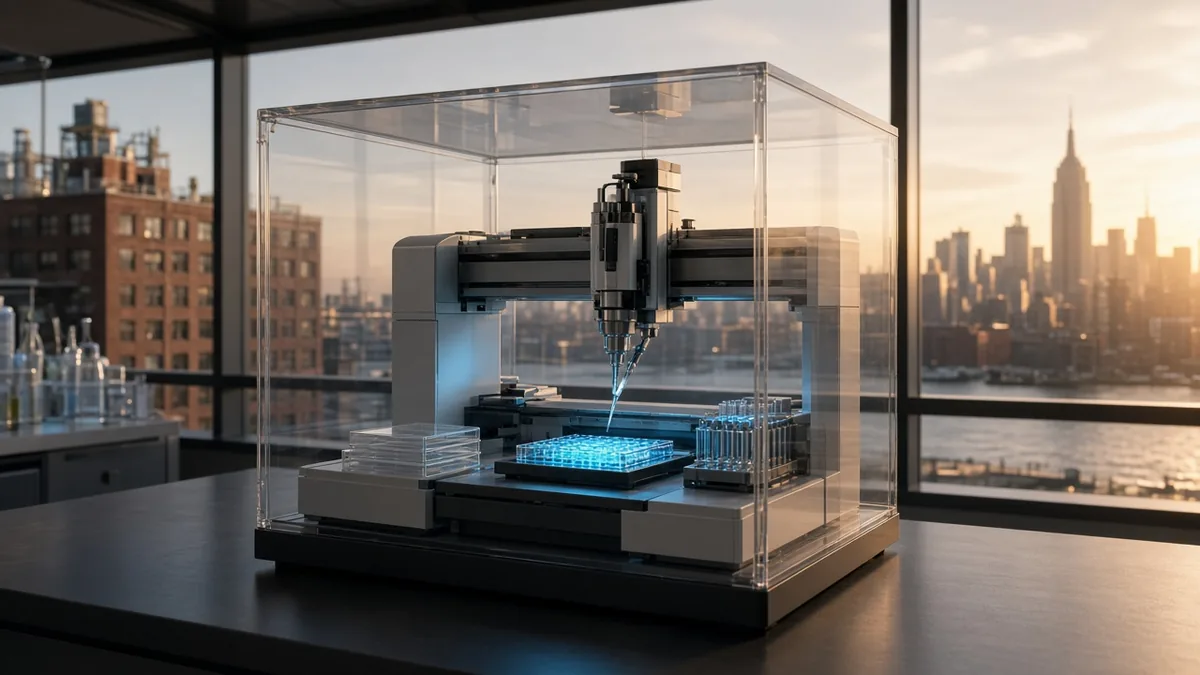
Founded in 2014 and headquartered in New York City, Opentrons builds benchtop robots that handle the repetitive liquid work at the heart of biology labs. SiliconANGLE described them as motorized pipettes inside transparent enclosures that move small amounts of liquid between samples.
The company sells two main robots. The Flex is the more advanced one: it can process more samples at once and use an optional robotic gripper to move plates, so more steps of an experiment run without a person stepping in. The OT-2 is smaller and less expensive, aimed at labs that want to automate routine pipetting without paying for Flex’s capacity. Labs use them for common tasks such as DNA extraction, PCR, protein purification and ELISA tests, SiliconANGLE reported.
Opentrons says it has deployed more than 11,000 robots to labs in more than 80 countries, including at every top-20 U.S. research university and 14 of the top 15 global biopharma companies.
The Pitch: The Lab Is the Bottleneck
The company’s argument is about speed. “While AI is transforming how science is conducted, the physical lab has become a bottleneck,” Opentrons said in the release. “Scientists can use frontier models to generate hypotheses and design experiments far faster than laboratories can test them.”
Its answer is to make its robots the place where AI-designed experiments actually get run, and to make every run produce structured, reproducible data that can feed back into the next round. The company calls this “autonomous science.”
“Millions of scientists spend much of their day on manual work a robot can do,” CEO James Atwood said, as quoted by SiliconANGLE. “Giving that time back to discovery is the biggest opportunity in science.”
James Flexner, managing partner at Avego, framed the bet the same way. “Every AI-driven discovery still has to be tested in a real lab,” he said in the release.
Where the Money Goes
According to the release, the Series E will fund:
- AI-driven experiment execution, so systems can design, run and learn from experiments toward a customer’s goals.
- Faster protocol development through its software and AI.
- Broader capabilities across its robots and instruments, and deeper integration with other lab automation tools.
- Expansion into new markets and geographies.
The company did not disclose its valuation or revenue.
Why New York Founders Should Pay Attention
Opentrons is a useful example of what a New York science company can look like: a hardware-plus-software company, built in the city, selling into labs around the world. Its backer list, which the company says includes Lerer Hippeau and Y Combinator alongside SoftBank, Khosla Ventures and Sands Capital, spans New York and Silicon Valley money.
There are lessons for founders outside biotech too:
- Being “open” can be a moat. Opentrons describes its robots as open and API-driven. Letting outside developers and AI tools control the hardware is part of why it can now pitch itself as the place where AI meets the lab.
- Installed base matters when the market shifts. More than 11,000 robots already in labs gives the company a head start as customers look for AI-ready equipment.
- Pick the bottleneck. The company’s story isn’t that AI is magic. It’s that one step in the process, running the physical experiment, can’t keep up, and it sells the fix.
For a city that wants more companies building real things, a Queens-based robot maker raising a Series E on an AI story is worth noting. Whether autonomous science arrives on the timeline investors hope is the open question. The robots, at least, are already on the bench.
Entrepreneurs Of New York is an independent publication and is not affiliated with Opentrons or its investors.