

BeSound Opens a Flatiron Flagship, Betting That Breast Screening Can Run Like a Consumer Tech Product
Women-founded health tech company BeSound has opened its New York City flagship in Flatiron, offering FDA-approved 3D automated breast ultrasound booked online with no referral. The opening shows how founders are pairing hospital-grade hardware, a retail-style experience and an AI data strategy.
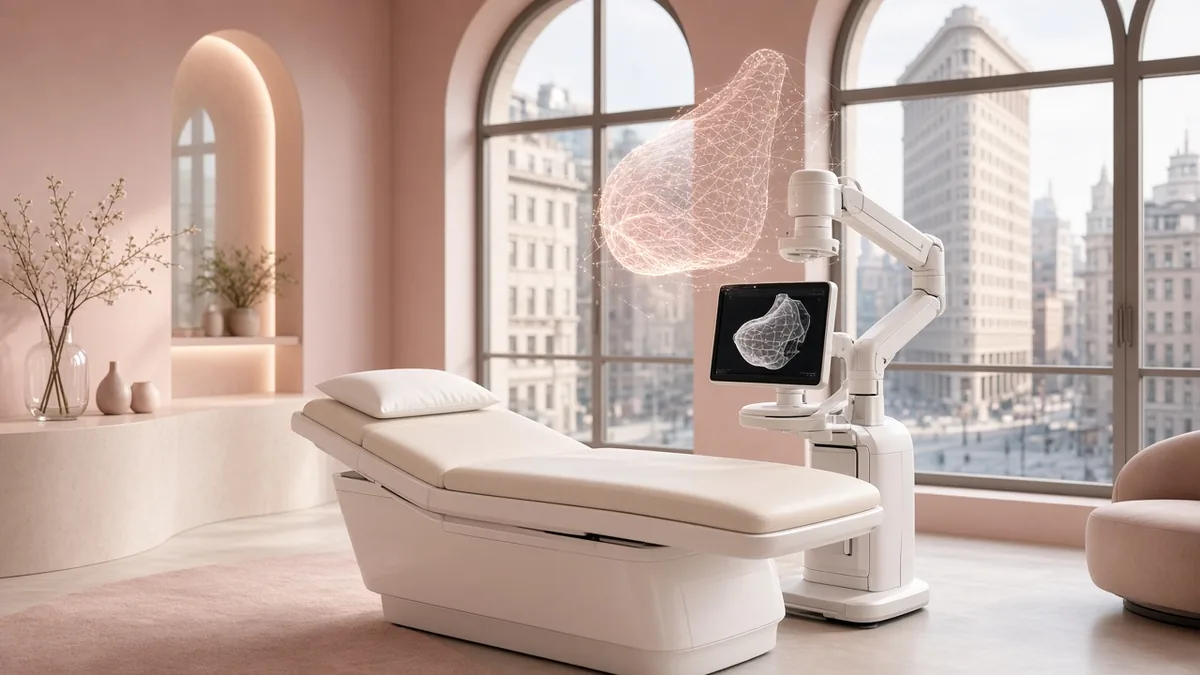
NEW YORK — A new storefront in Flatiron is trying to make one of medicine’s most dreaded appointments feel more like booking a fitness class. BeSound, a breast imaging company founded by former NASA quantum physicist Bailey Renger, opened its NYC flagship in mid-October as it lays the groundwork to expand nationally.
For New York founders, the opening is worth a look whether or not health care is your field. It’s a clear example of a playbook that keeps showing up in consumer health: take proven, regulated hardware, wrap it in a better customer experience, and use the standardized data it produces as the foundation for an AI product.
What BeSound Offers
According to the company’s announcement, women can book online in minutes with no referral, get same-day appointments and receive results within 24 to 48 hours. The scan uses 3D automated breast ultrasound, known as ABUS, which involves no compression, radiation or contrast dye.
BeSound’s scans run on Invenia ABUS, a system made by GE HealthCare. The company describes it as the first FDA-approved supplemental ultrasound screening technology designed specifically to detect cancer in dense breast tissue, and says that, used alongside mammography, ABUS has been clinically shown to detect 55% more invasive cancers than mammograms alone.
The medical reason for the business is dense breast tissue, where, BeSound says, up to 40% of cancers can be missed by mammography. When BeSound announced its seed funding last year, Fortune reported that about 40 million women in the U.S. have dense breast tissue, and that the FDA updated its mammography rules in 2023 to require facilities to tell patients when they do. “The current infrastructure does not support 40 million women now coming in for an ultrasound scan every year,” Renger told Fortune.
The company is careful about its claims. Its announcement says BeSound supports current screening guidelines and does not recommend replacing mammography for eligible women. Clinical services are provided by independent partner medical groups, and BeSound says it is not itself a health care provider.
The AI Angle
The technology story is less about the scanner than about the data. Handheld ultrasound depends heavily on the skill of the person holding the probe. An automated system captures a standardized, full-volume 3D image of the entire breast every time.
That consistency is what BeSound says it is building on: an AI layer trained on a growing library of structured breast imaging data, meant to help physicians read scans faster, surface findings earlier and track how a woman’s tissue changes over time.
“AI doesn’t replace the physician,” Renger said in the announcement. “It can give them a sharper view, and it can give women answers sooner.”
It’s a useful lesson for any founder building with AI. Models are only as good as the data behind them, and messy, inconsistent inputs make for weak products. BeSound’s strategy starts by standardizing how the data gets collected in the first place.
From Los Angeles to Manhattan
BeSound raised $6.8 million in 2025 from investors including Overwater Ventures, Kindred Ventures, Muse Capital and Lux Capital, as well as Oura CEO Tom Hale, Fortune reported. The company first launched in Los Angeles, where Fortune said a breast ultrasound would cost $350. We could not find published pricing for the New York location in the materials we reviewed, so check BeSound’s site for current details.
Renger has described BeSound as a “front door” to hospitals: it handles initial screening and then sends patients to doctors for next steps. The company says it expects, by the end of 2026, to offer insurance-covered scans through multiple payers in New York and other markets, along with a mobile van to bring screening to more communities and employer partnerships.
What New York Founders Can Take From It
Choosing Flatiron for a flagship is a statement about who the customer is: busy, digitally fluent people who expect to book on their phones and get answers fast. That is the same customer Manhattan’s boutique fitness studios, dental chains and direct-to-consumer brands have chased for years.
The employer angle is also worth watching for small companies. If BeSound and similar services build employer partnerships, a growing business may be able to offer screening as a perk without running its own health program. Any founder considering that should talk to their benefits broker about what their health plan already covers.
The bigger takeaway is the model itself. BeSound didn’t invent a new scanner. It bought an approved one from one of the world’s largest imaging companies, built a better front door around it, and is betting that the data from thousands of consistent scans becomes its real moat. Founders in other fields, from home inspection to industrial maintenance, can ask the same question: where could a standardized process create the clean data that makes AI actually useful?
The company’s next tests are practical ones. Insurance coverage, physician adoption of its AI tools and demand outside early-adopter neighborhoods will decide whether the Flatiron flagship becomes the first of many.