

Brooklyn's Ultra Raised $50 Million to Lease Robots, Not Sell Them. Here's Why That Matters
Industry City robotics startup Ultra closed a $50M Series A led by Framework Ventures. Its robots-as-a-service model offers a lesson for New York hardware founders and the warehouses that might hire its machines.
NEW YORK — Most of the money in robotics right now chases machines that look like people and are still years from steady work. Ultra, a startup based at Industry City in Brooklyn’s Sunset Park, took a different bet: build a robot that does one unglamorous warehouse job today, and rent it out by the month.
That bet just got a lot bigger. Ultra closed a $50 million Series A led by Framework Ventures with participation from Y Combinator, according to the company’s law firm, Gunderson Dettmer. Combined with an earlier $12 million seed round led by Y Combinator and NextView Ventures, Ultra has raised $62 million, Fortune reported when the funding was announced on Oct. 9. Fortune also reported that Ultra is deepening a partnership with Physical Intelligence, an AI research company that builds models to control robots.
What the Robot Actually Does
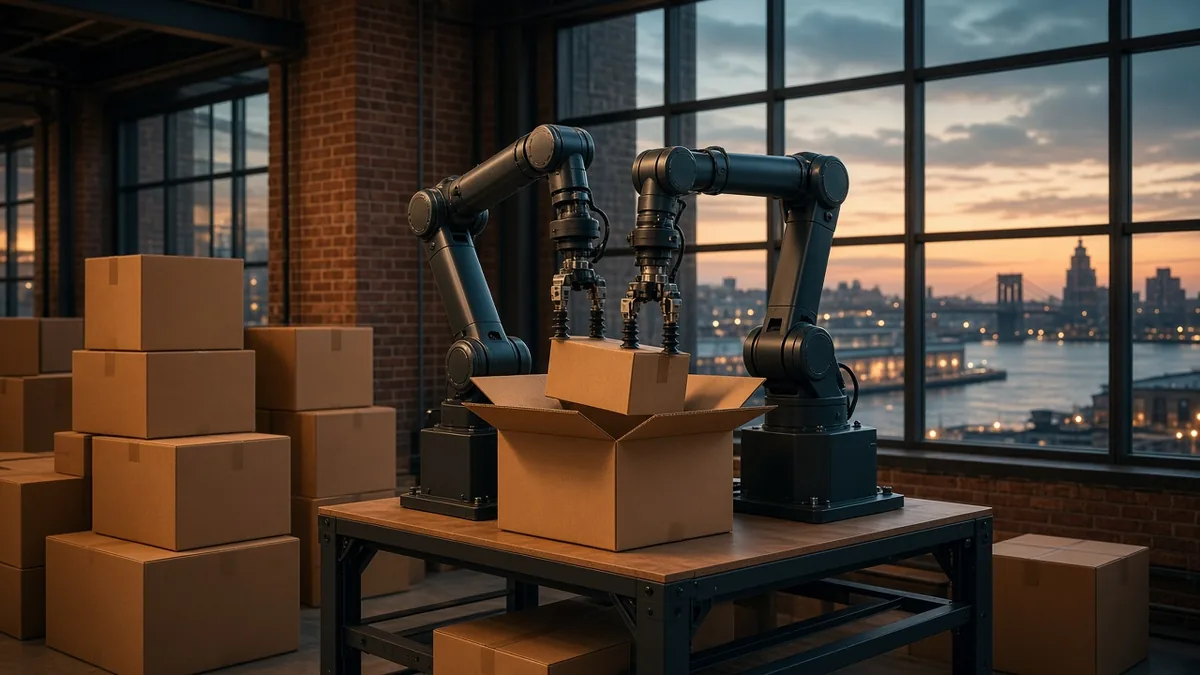
Ultra’s machine is called Operator, or OP1, and the company launched it in spring 2026. In an interview with AlleyWatch, CEO Jon Miller Schwartz said it goes “from a robot in a crate to a robot that’s fully set up and working” in less than a day. The robot is stationary and plugs into a standard power outlet and Ethernet, so it doesn’t stop to recharge.
Its first job is order packing, the last step before an online order ships. That’s the work of putting cosmetics, vitamins, apparel, electronics and home goods into mailers and boxes. SiliconANGLE reported that the robot can also sort mixed inbound shipments, assemble multi-item orders, seal packages and apply labels, and that Ultra says a single unit can process up to 1,000 items a day.
According to AlleyWatch, Ultra’s robots have packed more than 500,000 orders at sites in New York, Georgia, New Jersey and Texas. The customers are mostly third-party logistics companies, or 3PLs, the warehouses that store and ship goods for e-commerce brands. One early customer, Highline Commerce, is also based at Industry City, which Schwartz said let the two companies work on the robot’s development side by side.
The Business Model Is the Story
For founders, the most interesting part isn’t the hardware. It’s how Ultra sells it.
Traditional warehouse automation usually means a large upfront purchase and weeks of integration. Ultra instead leases its robots under a robots-as-a-service model. Fortune reported that customers pay an upfront integration fee and then a monthly fee that covers hardware, software and support. Schwartz told Fortune the model has gained enough traction that Ultra has been able to raise prices. He did not disclose revenue.
That structure solves two problems at once. For a 3PL working on thin margins and seasonal spikes, a monthly fee is easier to approve than a big capital purchase, and easier to walk away from if the robot doesn’t earn its keep. For Ultra, recurring fees look more like software revenue, which is easier to explain to investors.
Explaining that difference was, by Schwartz’s account, the hardest part of the raise. “Investors typically look at what’s happened with digital AI — OpenAI, Anthropic — as a baseline for how robotics will play out,” he told AlleyWatch. “But robots are hardware-based products that require a supply chain and production and operations support to actually deploy and run.”
What It Means in New York
For hardware founders: Ultra is a reminder that New York can support companies that build physical things, not just software. Schwartz told AlleyWatch the company has been at Industry City since 2024 and plans to move into a larger space there in the new year to fit a growing team and more robots. He credited the city’s “incredible density of technical talent” as Ultra hires.
For warehouse and fulfillment operators: The pitch, a robot that fits into an existing packing station without rebuilding the floor, is aimed squarely at the mid-sized operators that fill industrial space in Brooklyn, Queens and northern New Jersey. Anyone evaluating it should ask the obvious questions: what the integration fee covers, what happens on a bad day when a robot is down, and how throughput compares with a trained human packer on their own product mix.
For e-commerce brands: If your 3PL starts automating packing, ask how it affects error rates, packaging options and peak-season capacity, and whether any savings reach your invoice.
What’s Next
Schwartz told AlleyWatch that Ultra estimates it will have hundreds of robots deployed in 2027, and that the company is working with robotics labs to make its fleet fully autonomous. Asked for advice for New York companies without fresh funding, his answer was short: “Make your product better, work with your customers more, and grow your company.”
Whether robots-as-a-service holds up at hundreds of units, where support and repair costs pile up, is the real test. For now, a Brooklyn startup has $50 million to find out.
Entrepreneurs Of New York is an independent publication and is not affiliated with Ultra or its investors.