

Street Torn Up Outside Your Shop? NYC's New Construction Relief Law Could Cover Up to $10,000 in Costs
Local Law 163 of 2026 requires NYC's Department of Small Business Services to fund BIDs and community groups that help small retailers hurt by long city roadway projects, including reimbursements of up to $10,000 per business for costs like rent and wages. Who qualifies, when it starts, and what owners can do now.
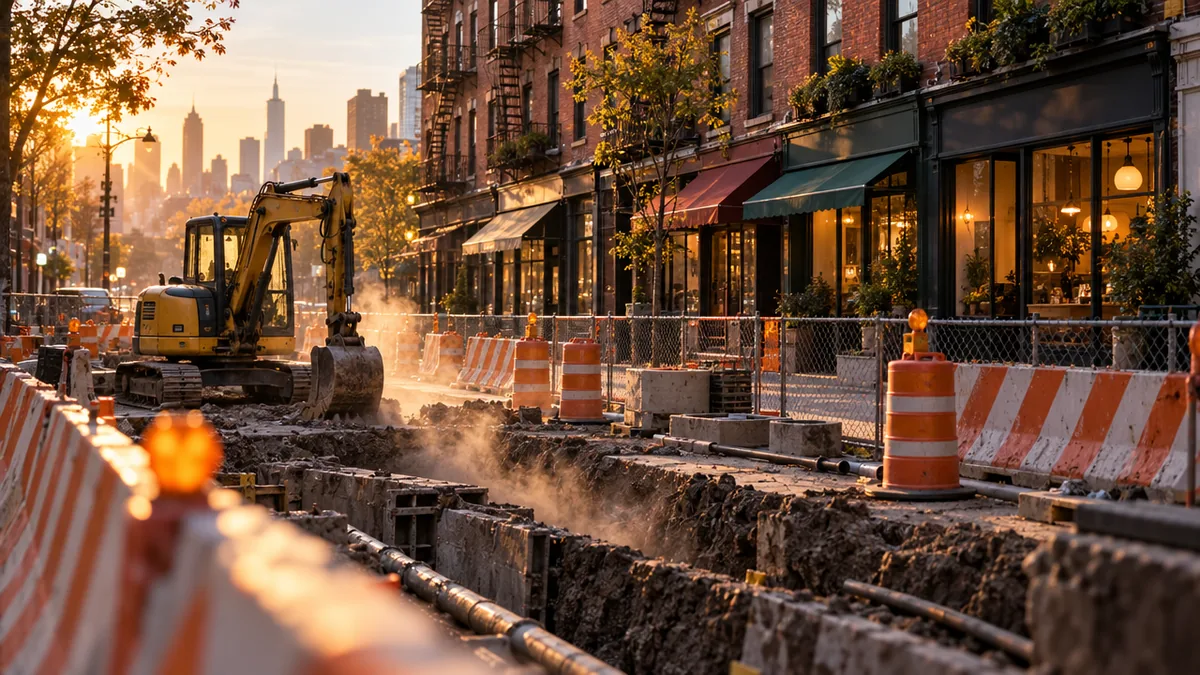
NEW YORK — Ask any shop owner on a block that has been fenced off for a water-main job or a repaving project, and you’ll hear the same story: fewer customers walking by, storefronts hidden behind barriers, noise, dust and a revenue dip that lasts as long as the work does. New York City now has a law aimed at that problem.
Introduction 799-A, sponsored by Council Member Yusef Salaam, became Local Law 163 of 2026 on Nov. 7. The City Council passed it on Oct. 8, and the Council’s legislative record shows it became law without the mayor’s signature and was returned unsigned on Nov. 9. It requires the Department of Small Business Services (SBS) to create a support program for small retailers hurt by city roadway construction.
Why the Council Acted
According to the Council’s announcement, the city’s Department of Transportation (DOT) maintains more than 6,300 miles of streets and highways, and there are more than 3,500 DOT-authorized street and roadway construction closures affecting more than 1,880 blocks citywide.
“When the City closes a street for months, the small businesses on that block often lose customers and revenue they can’t easily recover,” Salaam said in the release. Speaker Julie Menin said business owners “should not be left to deal with those challenges alone.”
How the Program Works
The money doesn’t go straight from the city to individual shops. Under the final text of the law, SBS will give grants to “eligible community-based organizations,” which then help the businesses. The key details:
- Who gets the grant: a nonprofit that is either the management group of a business improvement district (BID) where the project is located, or an organization with a history of working with small retailers affected by construction.
- Grant size: up to $100,000, with no more than one grant per construction project. SBS must consider how many small retailers are in the area and what help the organization plans to offer.
- What it can pay for: services such as district marketing, public art, creative lighting, wayfinding, open-streets and night-market activities, digital advertising and merchant organizing.
- Direct reimbursements: the organization can reimburse a small retail business for “covered costs,” such as employee wages or rent, that the business can’t cover from its revenue because of the construction. A business can receive no more than $10,000 in total.
Which Projects Qualify
Not every orange barrel counts. A “qualifying construction project,” as determined by DOT under SBS rules, must:
- Be authorized by a DOT permit for at least 90 consecutive days, including shorter permits that are renewed or extended to reach 90 days
- Be performed by or for a city agency
- Require the full closure of a roadway or sidewalk
- Be within one block of a commercial corridor
The help covers small retailers within two blocks in any direction of the project. Applicants must include the DOT permit number in their grant application. That means utility work by a private company or a short-term lane closure likely won’t qualify.
When It Starts
Not yet. The law takes effect 180 days after it became law, which works out to early May 2027, and it expires three years after that. The grant program is also “subject to appropriation,” meaning it depends on the city budgeting money for it. SBS must also write rules covering application procedures, which costs can be reimbursed, what documentation businesses must provide and how spending will be audited.
The Council also passed Resolution 328, which calls on the state Legislature to create a tax credit for businesses hurt by infrastructure construction. A resolution is a request, not a law, so there’s no state credit as of now.
What Owners Can Do Now
Talk to your BID or merchant association. Because the money flows through local organizations, your BID or a neighborhood business group will be the one applying. Let them know if your block is affected or about to be. If your corridor has no BID, find out which community groups work with merchants in your area. Our guide to how NYC business improvement districts work explains the basics.
Start documenting. Reimbursements will require proof that construction, not a slow season, caused the shortfall. Keep monthly sales records, photos of the closure and its dates, and rent and payroll records. A before-and-after comparison will be stronger than an estimate.
Look up the permit. The law points applicants to DOT’s online permit information. Knowing the permit number, start date and expected length of the work near you will help your local organization move quickly.
Watch for SBS rules. The agency’s proposed rules will spell out eligibility and paperwork. Proposed city rules are typically posted for public comment, which gives owners a chance to weigh in before they’re final.
Don’t wait for May. If a long closure is hitting you now, ask SBS about existing help through its NYC Business Express Service Team and your local business groups in the meantime.
The new law won’t make a torn-up street any quieter. But for small retailers who have watched customers disappear behind a construction fence, it’s a recognition that the cost of fixing the city’s streets shouldn’t fall entirely on the shops along them.