

Nidus Raised $30 Million to Put Robotics AI Inside Defense Factories, and It Wants to Build the Lab in New York
Nidus, a New York robotics startup founded this year by four alumni of defense tech company Vannevar, announced $30 million led by Kleiner Perkins and Costanoa to train AI models that help existing factory robots do precision assembly, starting with wire harnesses. What its playbook says about building hardware-adjacent AI in the city.
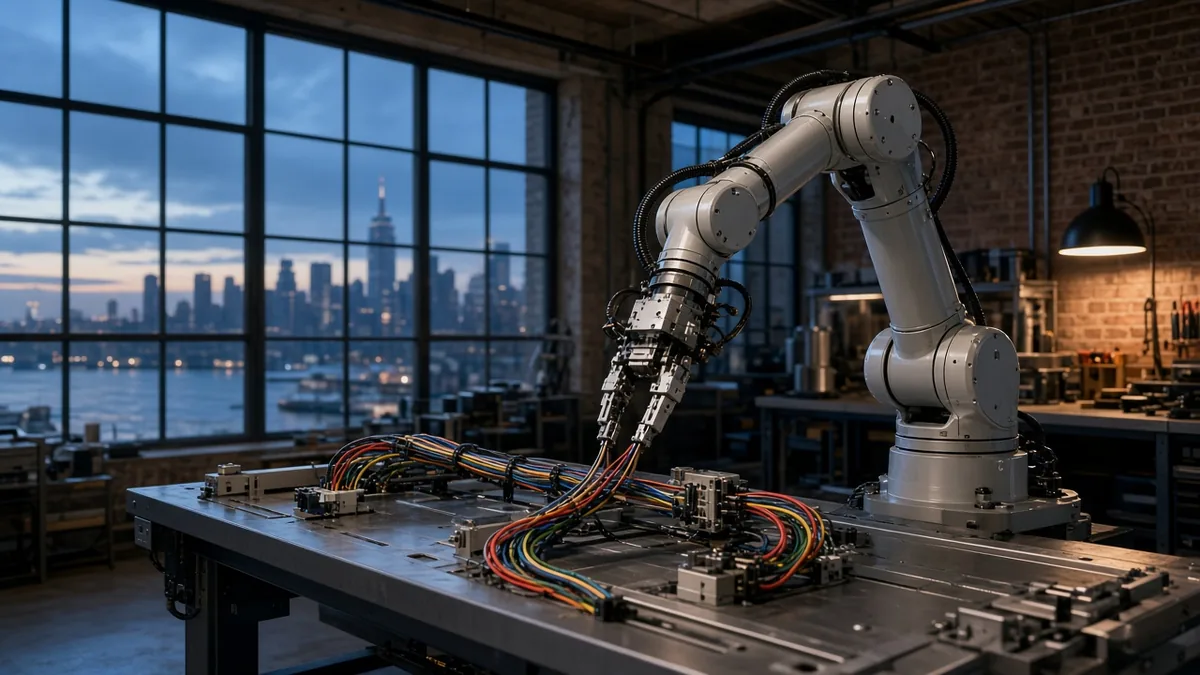
NEW YORK — The newest robotics lab in New York isn’t trying to build a humanoid that folds laundry. Nidus, a startup founded this year, wants to make the robots already sitting in American defense factories better at the fiddly, hours-long assembly work that people still do by hand. On Nov. 10 it announced $30 million in funding backed by Kleiner Perkins and Costanoa, and it says it plans to spend a good part of it hiring in New York.
The Round
According to the company’s announcement, the money comes from Kleiner Perkins and Costanoa, with participation from Ludlow Ventures, SF1, Absolute Partners and Tau, plus angel investors including Hadrian founder Chris Power, Adrian Aoun and Archer chief commercial officer Nikhil Goel.
Upstarts Media, which reported the raise exclusively, broke the $30 million into two pieces: a pre-seed led by Costanoa and a seed round led by Kleiner Perkins. AlleyWatch’s daily funding report lists the founders as Justin Sealy, Charu Dwivedi, Harrison Nguyen and Cane Punma. Upstarts reported that all four previously worked together on the hardware team at Vannevar, the defense technology company, and that the startup has about a dozen people.
Sealy, the CEO, framed the company around manufacturing capacity. “At this point, we can’t out-labor or out-scale our competition,” he said in the announcement. “We need to leapfrog the rest of the world by deploying physical AI that scales America’s existing industrial capacity.”
What Nidus Actually Does
Nidus describes its product as “embodied intelligence” that lets traditional industrial robots perform precision assembly. Its first target is the wire harness, the pre-built bundle of cables and connectors that goes into aircraft, missiles, vehicles and satellites. Harness work involves routing, cutting and terminating many individual wires, and much of it is still done by people.
Upstarts described the method: the team performs the same precise tasks thousands of times on teleoperated robotic rigs, and the data from those repetitions is used to fine-tune existing AI models, initially open-source and now frontier models, for a specific factory task. The resulting model is then deployed alongside a robot a customer already owns, so the plant doesn’t have to rebuild its production line from scratch. The company says it trains customer models using what it calls sovereign AI practices, so each customer keeps its own data and know-how, which matters in secure defense facilities.
The traction claim is notable for a company this young. Nidus says it passed seven figures in revenue within its first four months, and Upstarts reported more than $1 million in bookings with unnamed defense industrial customers. The company plans to expand from wire processing into other workflows; Upstarts listed kitting, pre-assembly and printed circuit boards as next steps.
Why the New York Angle Matters
Defense hardware companies tend to cluster near test ranges and factories, not in Manhattan. Nidus is betting the other way. Upstarts reported that the founders want to “hire aggressively” at their New York headquarters to build a leading robotics AI lab in the city.
That fits a broader pattern on this site’s funding beat. New York has been adding physical-world AI companies, from Opentrons’ $40 million Series E for AI lab robots to Brooklyn warehouse-robot maker Ultra Robotics.
The round is also large for a seed. Dealroom said a $30 million round ranks in the top 1% of U.S. AI seed deals by size in its sample, though it is small next to the biggest defense autonomy financings this year.
Lessons for New York Founders
You don’t have to sell to the Pentagon to learn from Nidus’s approach.
Sell into existing equipment. Nidus’s pitch is that customers don’t need new factories or new robots, just a model that makes the robot they already own more capable. For founders selling to conservative buyers, an upgrade that slots into current operations is usually an easier yes than a replacement.
Pick one narrow, painful task first. Wire harnesses are a specific, labor-heavy job with a clear before and after. Starting there gives the company a measurable result to show the next customer before it widens to other workflows.
Turn grunt work into a data moat. The team’s own repetitive teleoperation is the source of its training data. Founders in any vertical AI category should ask what proprietary data only they can generate, and whether doing the unglamorous work themselves is the fastest way to get it.
Lead with deployment, not demos. Kleiner Perkins partner Aatish Nayak said in the announcement that value in physical AI “will accrue to players that prioritize deployment and customer value.” Early revenue from real installations did more for this round than a research roadmap would have.
Respect the customer’s security needs. Nidus says its platform was built from the start to meet Defense Department security requirements, and that each customer keeps its own data. Founders selling into finance, health care or government can borrow that approach: make data control part of the product, not an afterthought.
What to Watch
The next tests for Nidus are whether it can turn early bookings into repeat production deployments, how quickly it moves beyond wire harnesses, and how many of the engineers it plans to hire end up in New York.